


Why technology, regulation and brand demand are creating a new investment opportunity in circular textiles.
Executive Summary
- The textile industry generates 114 million tonnes of waste globally every year, yet less than 1% gets recycled. The rest goes to landfill, representing an estimated $100 billion in lost economic value annually – a problem the industry has known about for years and largely failed to solve.
- An earlier wave of sustainable textile innovation focused on replacing materials rather than recovering them. Companies developing bio-based fibers, mycelium leather, and plant-based alternatives attracted significant capital in the early 2020s, but most failed or restructured as fiber performance, pricing, and adoption at scale proved far harder than expected. The sector is now turning its attention to recycling what already exists instead.
- That shift is being driven by three forces: major fashion brands have made contractual commitments to using more recycled content, EU regulation is mandating separate textile waste collection and traceability across all member states, and recycling technologies are getting close to industrial readiness. For example, eight new recycling plants with a combined capacity of 475,000 tonnes per year are either operational or in build around the world.
- Capital has followed, with over €1 billion invested across 228 equity deals in textile recycling globally over the past decade. But the infrastructure to deploy those technologies at scale hasn’t been built yet, capital requirements are steep (building a single recycling facility can cost €150-300 million), and critical upstream bottlenecks in sorting and feedstock preparation remain unsolved. These are the conditions where early investors can capture disproportionate value.
- The window is opening. Sorting technology has matured to the point where automated, AI-driven systems can identify fiber composition without relying on labels. Chemical recycling startups are moving from pilot to demonstration scale. Regulatory enforcement, particularly around Extended Producer Responsibility (EPR), is set to materialize from 2026. The infrastructure is emerging, the question is who builds it.
The Textile Recycling Opportunity
The fashion industry is one of the most polluting sectors on earth, and almost none of the damage happens at the point of sale.
Globally, around 114 million tonnes of textile waste are produced every year. Of that total, 14 million tonnes are collected, and just 1.4 million are actually recycled back into new fibers. The remaining 99% is incinerated or sent to landfill, representing an estimated $100 billion in annual economic losses. The extraordinary irony is that most of this material is not true waste at all. Around 60% of collected textiles are suitable for direct reuse and a further 35% for redeployment. Only 5% cannot be recovered.
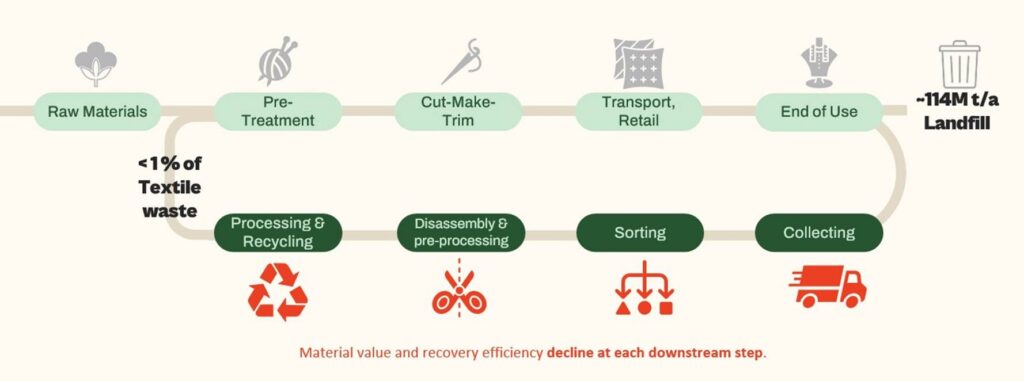
The explanation for this gap is structural. Brands capture the most value in the textile chain, while suppliers upstream face the burden of innovation with little power to monetize it. The chain is fragmented, with many players and no single party with the incentive or leverage to fix the whole system.
For years, the dominant response was to try to replace the problematic materials entirely. The early 2020s saw a surge of ventures bringing new fibers to market, including bio-based materials, mycelium leather, pineapple-leaf alternatives, and cultured animal hides. Companies including Piñatex, Natural Fiber Welding, and Bolt Threads all failed, restructured, or abandoned textiles entirely.
The same reasons persisted: fibres couldn’t match the performance, appearance, or wash durability of conventional materials, production costs made competitive pricing impossible, and the textile supply chain proved far harder to enter than expected.
Micke Magnusson, venture developer at Re-Access, has spent 15 years watching this play out. His description of the barrier captures why even technically sound innovations struggled to find adoption.
“You come to a manufacturer, maybe a third-generation spinner, and say, ‘Hey, I have a new yarn for you. Why don’t you just change?’” says Magnusson. “And that didn’t happen. People have met the glass wall.”
Now, innovators are exploring a different approach to solving textile waste. Instead of using more sustainable materials, they’re focusing on recycling what already exists. The value chain runs in four steps: collection, sorting, pre-processing, and recycling. Each step loses value and material efficiency, which is why improving them offers clear investment opportunities.
The market reflects that shift. The global textile recycling market was valued at $8.4 billion in 2025 and is projected to reach $11.9 billion by 2030, growing at a 7.2% compound annual rate.
What is Driving the Textile Recycling Market?
Technology
At least eight industrial-scale recycling plants are currently in planning or early operation across Europe, the US, and Asia, built by companies including Syre, Reju, and Circ. Their combined planned capacity is 475,000 tonnes per year, enough to meet current brand demand if the feedstock can be delivered to them cleanly and consistently.
Brand Demand for Recycled Textiles
Major apparel players have made binding commitments to recycled content by 2025-2030. H&M has committed to 100% recycled or sustainably sourced materials by 2030. Inditex has targeted 40% of fibers from recycling, with a further 25% from next-generation sources. Adidas, Nike, and Kering have all made similar pledges. Crucially, demand is increasingly contractual. H&M Group and Vargas co-founded Syre with a $600 million offtake agreement over seven years, while Inditex signed a €70+ million, three-year deal with Ambercycle for recycled polyester.
EU Textile Regulation
The EU’s Eco-Design for Sustainable Products Regulation (ESPR) requires digital product passports for textiles by 2030, promoting traceability and recyclability. The EPR framework requires brands and producers – including fast fashion and e-commerce players – to fund the collection, sorting, and recycling of textiles, with fees modulated by how circular the product design is. The Waste Framework Directive mandated separate textile collection across all EU member states from 2025. 2026 is the build year. 2030 is when compliance, costs, and enforcement will materialise.
In other words, the industry is being pulled forward simultaneously by technology, commercial demand, and the law.
Investment and Venture Dynamics in Textile Recycling
The capital is moving, but the infrastructure isn’t built yet.
More than 390 companies are now operating globally in circular textiles, concentrated in Europe, which has 185 startups, and North America, with 130. Asia, despite its dominance of textile production, accounts for just 54. The European concentration is largely policy-driven: the region’s regulatory ambition has created one of the most supportive ecosystems for new circular ventures anywhere in the world.
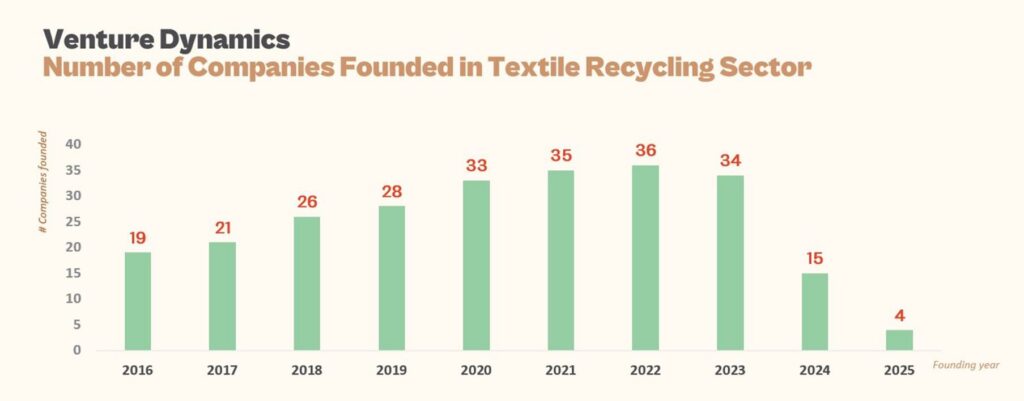
Startup formation accelerated sharply through the 2010s and peaked in 2022, when 36 new companies were founded in a single year. The count has since slowed. A recent study by Deutsche Welle and EDJnet analysed nearly 500 sustainability commitments from fashion brands and found that only half were actually met, with a third failing entirely – a signal that the demand founders were building toward has materialised more slowly than expected. The sector is transitioning from formation to industrial scaling, which requires fewer but much larger rounds.
Total equity invested across 228 deals now exceeds €1 billion, with the largest single round being the €92.5 million raise by Syre in 2024. Two dynamics are visible in the data: early-stage momentum is building, with seed and pre-seed rounds growing in size and frequency since 2023. Larger, growth-stage rounds are also beginning to appear, signalling the start of industrial scaling.
The most recent data shows a dip in both capital invested and deal count, but this is less alarming than it looks. It may partly reflect a reporting lag, where funding announcements take time to appear in the underlying dataset. More likely, it reflects a natural transition: many companies are now entering the capital-intensive scale-up phase, where fewer but larger rounds are needed to build demonstration and industrial plants. The sector is moving from startups to industrial bets.
But the capital picture is more complicated than the headline figure suggests. Building a single industrial-scale recycling facility can require €150-300 million, yet most leading startups have raised closer to €100 million. The sector is still largely pre-industrial in scale.
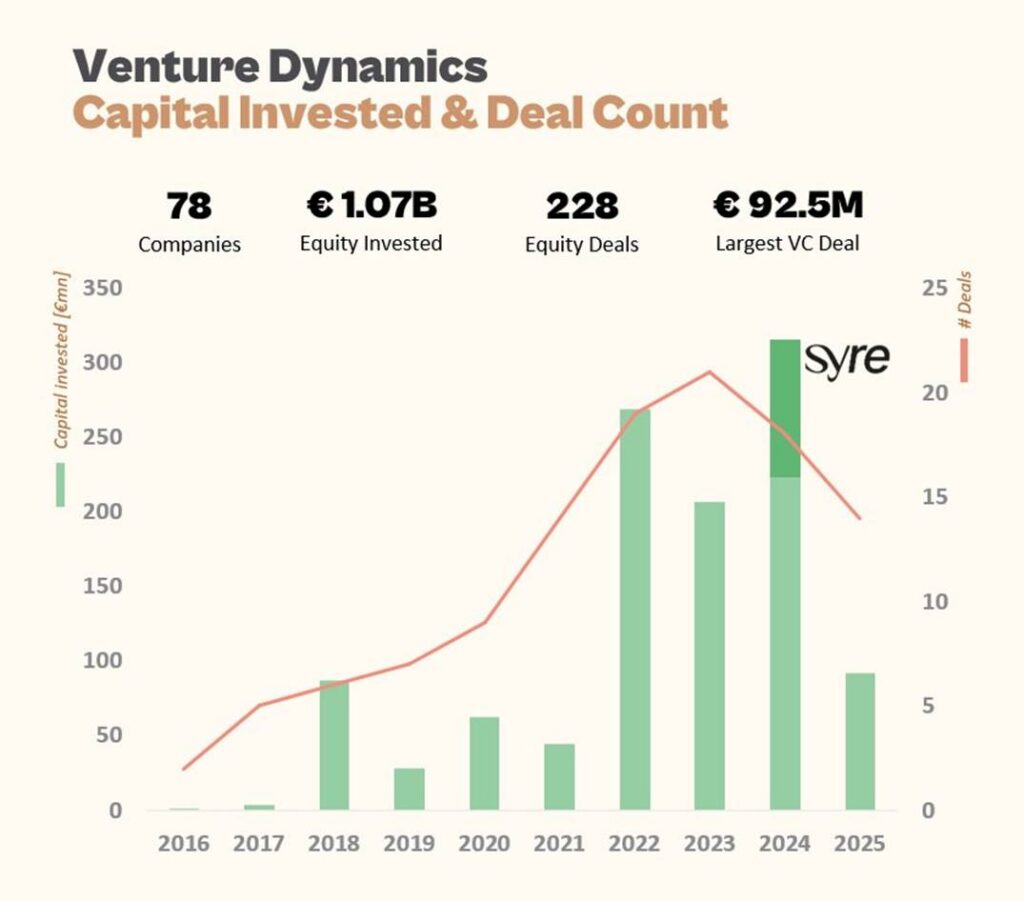
Investment is heavily concentrated in chemical and enzymatic recycling technologies. The most-funded companies – including Samsara Eco, Infinited Fiber, and Ambercycle – have raised between €40-100 million each, enough to move from pilot to demonstration scale but not yet to full industrial deployment.
An important structural dynamic is the growing role of fashion brands as direct investors. These arrangements do more than guarantee demand – they de-risk the business model for co-investors and validate the commercial thesis. For example, in 2025, Recover partnered with Intradeco to build a recycled cotton hub in Central America and signed multi-year supply agreements with both H&M Group and Primark.
Where Are the Investment Opportunities in Textile Recycling?
As recycling technologies move closer to commercial readiness, the most compelling investment opportunities are emerging around the bottlenecks that determine whether textile waste can be processed at scale.
Automated Textile Sorting
The more pressing constraint is emerging upstream. As chemical recycling technologies approach commercial readiness, the bottleneck is shifting to sorting and feedstock preparation.
The current infrastructure was built for reuse and export, not for material recycling. Rikke Bech, founder of sorting technology company NewRetex, has observed this tension first-hand from her facility in Denmark.
“There is still not enough money in textile-to-textile recycling because there isn’t very big demand,” she says. “A lot of the brands and producers are waiting for the regulation, so it’s like everybody is holding their breath right now.”
They won’t have long to go. The EU’s separate collection mandate took effect in 2025, which will substantially increase feedstock availability. EPR fees are expected to begin flowing to the sorting and collection infrastructure from 2026.
The sorting segment is attractive from a venture perspective for precisely this reason. It’s capital-light relative to recycling, technically differentiable, and an essential enabler of the entire downstream chain. Companies like NewRetex and Matoha are building proprietary AI and infrared spectroscopy systems that identify fiber composition without relying on garment labels.
Feedstock Preparation
Sorting alone is not enough. Recyclers require highly consistent feedstock, often with purity levels of around 98% for polyester or cotton. In practice, collected textile waste contains blends, contaminants and incorrectly labelled garments, making feedstock preparation a critical link between collection and recycling.
The label problem is more significant than it might appear. Hans Hon Sang Chan, founder and CTO of Matoha, has encountered it repeatedly with customers.
“They think our machine is wrong,” says Chan. “But fabrics are often mislabeled. We sourced a piece of fabric from a very reputable UK fabrics retailer and the label said it was polyester wool, when in fact it was a huge blend of different fibers which wouldn’t be recyclable in a polyester process.”
Chemical and Enzymatic Recycling
Further downstream, the challenge shifts from identification to chemistry. Dawn Technology, a spinout from chemical company Avantium, is developing a process that can handle the most common waste stream of all: polycotton blends. Peter Mangnus, CTO and Business Director at Dawn Technologies, explains the commercial logic.
“You need to have automated sorting capacity in order to feed such a plant,” he says. “And there is a disconnect between what Europe can do and what is happening in Asia.”
Dawn’s process converts the cotton fraction of polycotton into chemical building blocks while recovering clean polyester fibers, creating two revenue streams from a single waste input. It’s an example of a broader category of opportunity: technologies capable of processing the contaminated streams that current recyclers can’t touch.
The financial engineering required to fund this category is more complex than a standard venture round. Recycling plants require a blended capital stack across venture equity, grants, public co-investment, and debt. Micke Magnusson, venture developer at Re-Access, has spent 15 years watching investors learn this the hard way.
“It’s not an app. It’s not a 5x return in three years kind of business. It’s more cathedral thinking, industrial building,” he says.
Recycling Textile Blends
Sara Diez, CEO of The PostFiber, adds a further structural caveat that shapes where capital needs to go. Even as sorting capacity grows and collection mandates take effect, the recyclable fraction of what gets collected will remain limited until the blend problem is solved upstream.
“Even with collecting more, we’re not going to get into an easy place where most of the things that are getting collected will be suitable to be recycled,” she says. “There are very few solutions that are able to separate different types of blends. We need to keep investing in technologies that allow us to tackle a bigger portion of what can truly make a difference.”
Why Europe´s Textile Recycling Market is at an Inflection Point
Europe is at an inflection point with textiles.
The regulatory engine is switching on. Separate collection is now mandatory across all EU member states, creating a structural increase in available feedstock. EPR enforcement is expected to materialise through 2026 and reach full force by 2030. The ESPR’s digital product passport requirement will, for the first time, make fiber composition traceable and verifiable at scale.
Technology is matching that timeline. Sorting solutions that were unproven three years ago are now selling commercially. For example, NewRetex has been running its automated sorting line for nearly three years and has built a proprietary data set on waste stream compositions that did not previously exist. Chemical recyclers are moving from pilot to first commercial plant.
The competitive pressure is also sharpening. China is directing significant capital into making its own textile industry circular, moving fast on recycling infrastructure and technology adoption. Europe built the regulatory architecture and the venture ecosystem for this transition. Whether it captures the economic value depends on whether capital moves fast enough to match that head start.
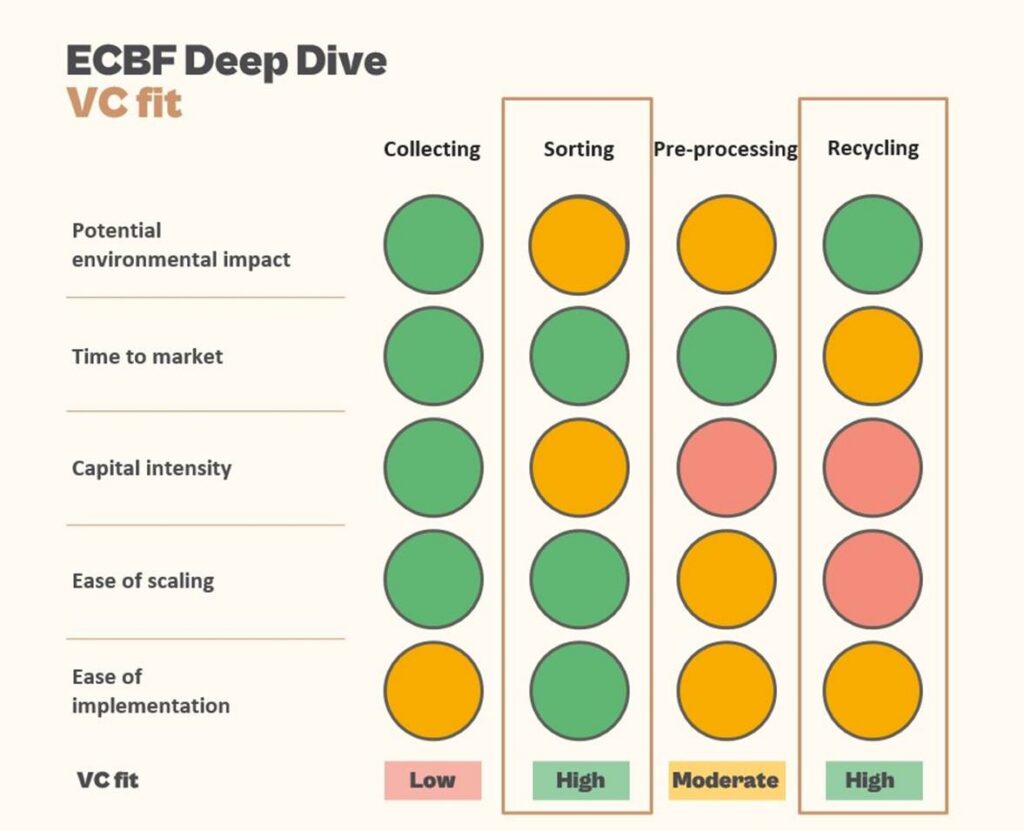
First-movers in this space enjoy three compounding advantages:
- Securing feedstock relationships with collectors and municipalities before those streams are contracted.
- Building the operational knowledge needed to navigate the EPR framework before enforcement drives up compliance costs.
- Locking in offtake agreements with brands whose 2030 commitments are now contractual obligations.
A textile recycling industry that captures even a fraction of the value currently destroyed in incineration is a very large industry indeed.
The direction of travel is clear to those building inside it. Magnusson sees the industry’s emergence as not just likely, but inevitable.
“We know that we don’t have raw material to satisfy our own needs,” he says. “In five years, there is going to be an industry built in recycling – with both failures, with huge successes – and there is no other way. I’m willing to bet everything I own that this is going to happen.”
Building the Future of Textile Recycling?
ECBF invests in companies shaping Europe’s circular bioeconomy. If you are building technologies across textile sorting, recycling, feedstock preparation or next-generation fibres — or are looking for a co-investment partner with deep sector expertise — we would like to hear from you.